
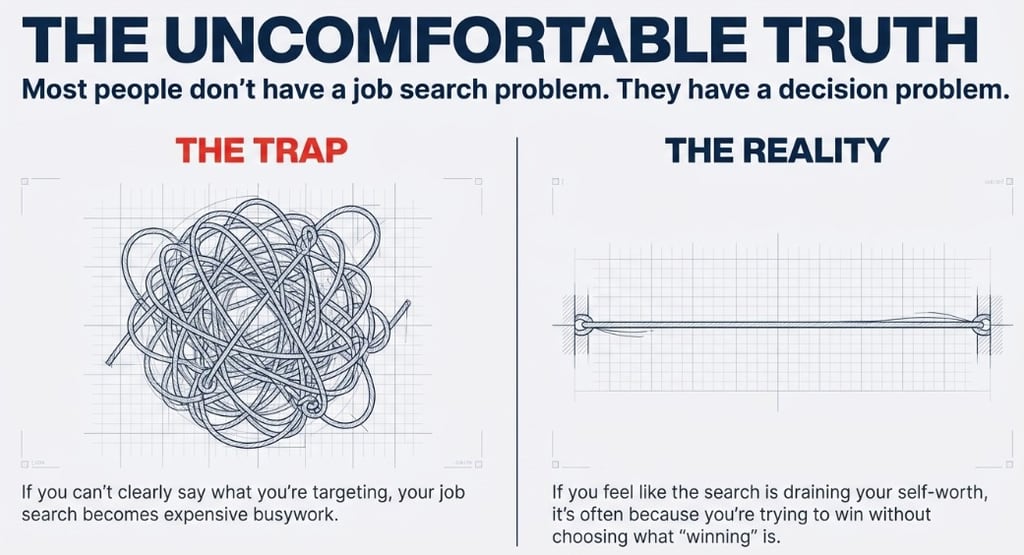
Most people don’t have a job search problem. They have a decision problem
CAREER CLARITYPERSONAL BRAND
3/2/20263 min read
Here is the uncomfortable truth: If you can’t clearly say what you’re targeting, your job search becomes expensive busywork.
The pain it creates (confusion, rejection fatigue, shame), this is the part nobody posts about on LinkedIn. When your target is fuzzy, you start doing “a bit of everything”:
applying to roles that sort of fit
tweaking your CV endlessly
networking randomly
starting courses you don’t finish.
And the emotional cost stacks up fast:
Confusion: you can’t explain your direction without a long backstory.
Rejection fatigue: you get rejected and you don’t even know what it means, because your aim was unclear.
Shame: you start thinking you’re behind or “not good enough,” when the real issue is that you’re asking the market to guess.
Decision paralysis: every job description feels like a referendum on your identity.
It's harsh but fair: if you feel like the search is draining your self-worth, it’s often because you’re trying to win without choosing what “winning” is. Why does this happens? This isn’t a personal flaw. It’s how modern job searching is designed.
Job boards reward activity, not direction
Infinite scroll makes “more applications” feel productive. But it’s a substitute for choosing.Smart people can genuinely do multiple things
High performers and career changers often have range. The downside is you start saying “I’m open to…” and the market hears “I’m not sure.”Choosing forces trade-offs—and trade-offs hurt
When you decide, you give up other options (at least for now). That discomfort creates avoidance, and avoidance looks like “applying widely.”Hiring is pattern matching
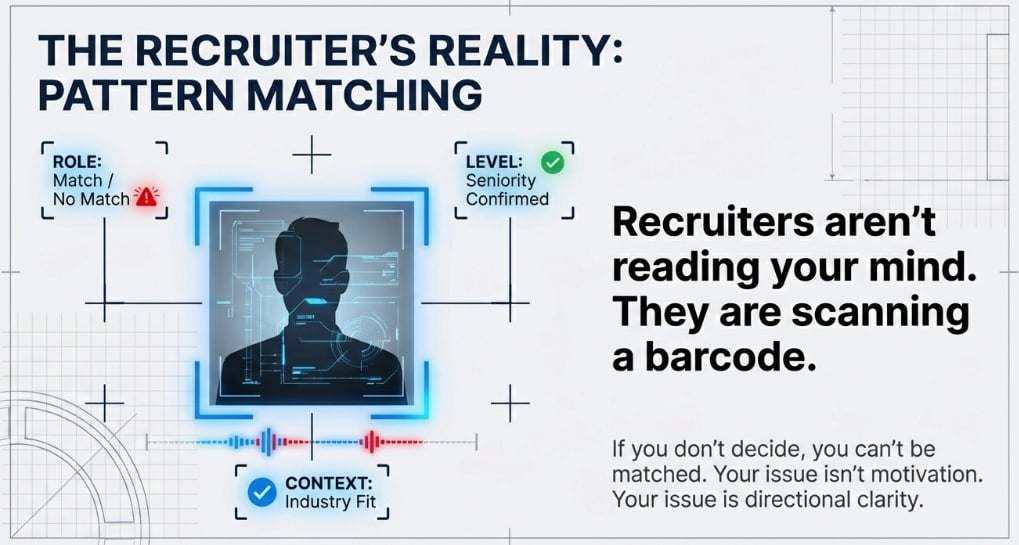
Recruiters aren’t reading your mind. They’re scanning: What role is this person? At what level? In what context?
If you don’t decide, you can’t be matched.
So no - your issue isn’t motivation. Your issue is directional clarity.
What to do instead ? Here is where the Stage 1 of our 5x5 Framework comes in place. Stage 1 exists for one purpose: choose the right roles and build a plan that can win. Here are the most relevant Stage 1 steps for this problem:
Step 1: Define target roles & level (2–3 titles, realistic seniority).
Choose 2–3 job titles you can credibly compete for right now. Not 12 titles. Not “anything in business", just two or three roles. This is the moment you stop asking the market to do the thinking for you. A good target list is specific enough to guide action, flexible enough to evolve:
“Customer Success Manager (B2B SaaS),” not “customer roles”
“Operations Manager / Program Manager,” not “strategy + ops + product + consulting”
Step 2: Set your criteria scorecard (non-negotiables + deal-breakers)
This is how you stop applying out of panic. Score roles against what actually matters:
salary floor
hours/pace
remote/hybrid/commute
values/industry boundaries
growth path
deal-breakers
Rule: if a role breaks two deal-breakers, it’s a no—even if your anxiety says “just apply.”
Step 3: Personal narrative (“why this role/industry now” + positioning statement)
This is where your decision becomes believable.Your positioning statement is not a motivational speech. It’s a coherent explanation:
what you do well (pattern)
what you’re targeting (direction)
why it makes sense now (timing)
When you have this, everything downstream gets easier:
your CV stops being a “maybe”
your LinkedIn stops being vague
your networking stops being awkward
interviews stop feeling like improvisation
If you want help choosing a focused target, building a criteria scorecard, and turning your direction into a positioning statement that recruiters actually understand, book a free 30-minute discovery call with Career Bridge Studio.
Contact us:
© 2026. All rights reserved.
Visual Bridge LTD T/A Career Bridge Studio
Online career coaching for professionals across the UK. Based in Milton Keynes.
CareerBridgeStudio
Apply better. Interview stronger.